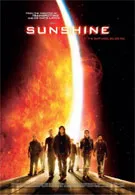
Danny Boyle has done it again: Sunshine is a rare example of an end-of-the-world film that gets it right. There are characters to care about amid the destruction, snappy dialogue to parallel the striking visuals, and a sense of tension to match the excitement. Rarely has the apocalypse been so inviting.
With the exception of A Life Less Ordinary, Boyle’s admittedly botched attempt at a romantic comedy, the director has a knack for shaking up genres. Trainspotting raised the bar for drug movies, 28 Days Later made zombies cool again, Millions showed his ability to tell a childlike fable with accessible maturity. It’s equally impressive that he made Sunshine, a special effects extravaganza, on a measly $40 million budget, compared with the bloated $125 million-plus cost of Armageddon. His “quality over quantity” take is refreshing like a sip of ice cold lemonade in the heat of summer.
Speaking of heat, it’s the core of Sunshine, an oddly chipper title for a movie about the sun burning out and leaving the world, set in 2057, frozen in a solar winter. A spacecraft named Icarus II--the first of which set out seven years before and never made it--carries eight passengers on a mission to reignite the sun: Capa (Cillian Murphy), the physicist who knows how to activate the bomb; Mace (Chris Evans), the ship’s engineer; Cassie (Rose Byrne), the pilot; Harvey (Troy Garrity), the communications officer; Searle (Cliff Curtis), the psychiatrist; Trey (Benedict Wong), the navigator; Corazon (Michelle Yeoh), the botanist in charge of maintaining the food and oxygen; and Captain Kaneda (Hiroyuki Sanada).

It’s a loaded, well-prepared ship, but anything that can go wrong does go wrong--Murphy’s Law tends to transcend Earth’s orbit. Once Trey mistakenly foils the coordinates, an accident that flushes the remaining particles of his sanity, their neatly mapped out plan quickly snowballs into several worst case scenarios. There’s a bit of a Final Destination game going on in this action sci-fi thriller, and you never know who’s next or how that person will meet his or her fate.
But unlike many movies of this kind, that’s not the most (or only) interesting element. It’s all in the little moments: For example, an opening scene of Searle staring adoringly, almost hypnotically, at the sun sets the tone for its strangely bewitching powers. Capa’s video home before they lose contact with Earth hints at the mixed emotions of the crew--they are hopeful that they will come home, but they know they might not, and that uncertainty takes a toll on them. For Mace, it results in throwing a few too many punches; for Harvey, a meltdown or two.
People will try to pigeonhole Sunshine as a 2001 knockoff, but it’s more like a throwback to a few different like-minded genre pieces, while still maintaining its own identity. The navigational computer in Icarus II, voiced by Chipo Chung, provides a blunt female counterpart to 2001’s HAL. Mace at one point makes a fitting Alien wisecrack. There’s a captivating scene of three spacemen getting beamed from one ship to another, a la Star Trek. And then there’s a brief homage to the sacrificial button-push in Armageddon.
Beyond these minor elements however, it’s unlike anything you’ve ever seen before. Sunshine is easily one of the most eye-pleasing movies ever created, giving a new perspective of outer space and a heightened appreciation of the sun, in all its glowing beauty. It’s understandable why the characters are drawn to it, in spite of its fatal possibilities--one man gets engulfed in a tidal wave of fireball heat because he literally can’t look away. Neither will you.
If the movie has one downfall, it’s the introduction of a tangible villain toward the end, on top of more interesting, more effective unseen evils. But otherwise, Sunshine has nearly everything going for it: flawed but sympathetic characters, great ensemble acting, stimulating dialogue (courtesy of Alex Garland’s script), a satiable amount of action, and enough twists and turns to keep you guessing.
Note: This website is not intended for use by minors. The views expressed in this comments section are not necessarily our own. Comments that we deem to be poorly worded, off topic, or threatening will not be published. For free, uncensored discussion visit our forum.
I think of myself as an astute observer of the physical sciences and therefore I was thoroughly disappointed with the situations that the story put in front of us.
What I liked:
I thought that the CG work was some of the best I have ever seen. On par with any recent film made. The scenes of the Sun and Mercury were beautiful, the space craft were beautifully designed and rendered. I also thought the psychology of the situations were good, one notable execption being the villan.
What I didn't like:
I think the science aspects of the movie were poorly handled and barely even on par with a basic sixth grader's knowledge of the physical world.
Technology did not match the problems
The sun will die in roughly less than 5 billion years. In 2057 the Sun will be happily doing what it has been doing for 4 billion years now. We will have many thousands of years to prepare a mission to save our Sun. Heck, computers have been around for roughly 60 years, while the microchip has been around for roughly 30 years.
Why did they not equip the space craft with better cameras? Has the earth not developed a better resolution camera than the ones they used? Why were the images of the villan's face on the display screens so poor?
As the last best hope for humanity, I am certain that the problems faced by the civilization in the movie would probably warrant the attention of the greatest engineers, scientists and creative minds on the planet. So why, did they not think that the solar protection panels would not need to be repaired while in direct contact with the Sun's corona? Maybe they should have included a small craft that would allow the repairs and provide a small section of shielded space to work. Hence the captain would be alive.
Fission does not mean Fusion
The Sun works on the process known as fusion. This process takes two atoms and with pressure from gravity fuses them together into a new larger atom. In the process energy is released. Nuclear bombs work on the process known as fission. This process takes one atom and with the a neutron the atom is split into two smaller atoms. In the process energy is released. So what good would it be to add fissionable material to a fusion reaction? Fission and fusion are kind of ,not exactly but close, reverses of each other.
Backup systems
In future space ships nothing would ever need to be entered manually, ever! Check, double check and quintuple check every course calculation you make by multiple computers. The computer is the one that actually fires the control rockets, so it would be in the process at some point They use this system on the space shuttle, now. Multiple computers make calculations and if one is wrong it is reported and the offending data is ignored. There is no need, after the 1960's-1970's to have humans enter anything in manually. So the guy who forgot to enter the shield readjustment angle when he made the course changes would be notified by the navigation computer. The computer already knew to change course when the crew was in danger, which led to the drama of the captains death. Why didn't the same safeguards prevent the shield from beind damaged?
In such an important mission as the savior of our planet, would the main computer not also have a backup, secondary backup and even probably a triple backup. Each system isolated from each other to prevent multiple failures. So even if the bad guy killed the main computer it would swith over to the backup system and resume function on a failsafe mode.
Villan
Was he possessed by a spirit, eg Devil, Demon, or was he just insane? If he was a Devil or Demon, OK, then that explains how he could withstand the Sun, while everyone else is vulnerable. That also might explain why the "camera" could not capture him correctly. Personally, I think it was a lazy, and poor decision by the director to try to fool us into being scared by putting "vaseline" on the camera while the character was in the screen. If he is real, then make him real and scary, let us see what makes the character scary. Don't obscure him. If this character is not possesed then he is even more preposterous than a Devil character. How could he survive for seven years of repeated extreme exposure to the sun. As was elluded to by his obsession with extra bright sunlight. I do understand a society that never had a full Sun would be obsessed with knowning what "full" sunlight would be like, so I can accept that peole would be obsessed by it. But the exposures they elluded to were they type that would destroy eye sight, hence the black pupils in the villan. With no eye sight, how could he function?
Dust
Plainly put there was way too much dust spread across the dead ship to constitute the dust being from the dead crew. There were times when the dust was at least 1/8 inch thick on the surfaces. I highly doubt that the skin, hair, and other parts of at most 6 people (7 crew members minus one mad man) would create a dust cloud that large. we can probably reduce that estimate to 4 people, as 2 bodies (possibly 3) were visibly intact in the observation room.
Airlocks
Why would you design a space craft with only one airlock? Backup systems, backup systems, how about a little redundancy in such a critical mission.
Space Suits
A crew of 7 means that you are more than likely going to have more than 1 space suit per ship. So why oh why was there only one space suit available? Because the villan jettisoned them, but magically left one for himself? I highly doubt it, he would probably have not jettisoned the suits and kept them all just in case one fails.
Explosive Decompression
If as a human you are subjected to a vacuum your body would explode long before your appendages would freeze. Your blood would boil and that would exert pressure outward on your skin. The type of freezing that the movie intended us to believe would happen to the crew members requires a mass of super cold liquid to carry the heat away from the body, since space is mostly a vacuum. There is no matter to carry the heat away from the body, except through infared radiation of the body. Which would take a lot longer than the few seconds it would take to space walk to the other airlock.
Also, there was really no time crunch to get back to the spacehip. So they could have ferried suits over and allowed everyone to come back. The air lock could have been operated manually by someone in a suit and they could have easily gotten everyone back to the ship. No need for a rash decision about who lives or who dies.
Cavalier attitude
Does anyone else think that the attitude of the crew was a little too gung ho? Lets fry the antenna, we won't need that until the return trip, and even so we will deal with it then. Like when our oxygen supply is low and everyone is nearly dead, then we can radio for help on our fried antenna.
Bomb Training for crew
Why, oh why would you only train one person to be able to make certain the bomb explodes? The guidance system is automatic anyway, so why not train everyone on that crew to be proficient in the bomb? So the entire fate of our planet rests on the shoulder of that one physicist? Why the heck are the other people along then? I would think that everyone would know how to work the bomb, know how to check it, deactivate it in an emergency, etc. The bomb is the most important part of the entire process. Heck, only staff the crew with people who have triple doctorates in physics, biology, and psychology. I am sure there are enough people on Earth with those credentials who would be willing to participate in that project.
Bomb Mass
In short the sun is 1.3 million times the size of the Earth, a mass of the entire Earth would not kick start the Sun back into submission. Let alone fissionalbe material two times the size of Manhattan. Even if they could get the reaction to start it would run out of control, the best you would see is an explosion not a prolonged increase in the Sun's intensity. They would need something to prevent the reaction from cascading out of control.
Shielding for return trip
How did they realistically plan to get back without any shielding? The mission called for them to maneuver close enough to the Sun to precisely drop the bomb, but once they dropped the bomb they had no shield left. The space ship was fragile enough to be destroyed by the Sun's rays, as could be seen from the antenna destruction scene.
Personally, I believe you have to frame the scary and uncertain aspects of the story, ie the villan and the psychological dilemas, in the reality of the world. It makes the uncertainty all that more effective. If the characters live in a world where there is no logic then how is the illogical frightening?
Actually you won't explode in a vacuum, but you won't suddenly freeze like what was depicted. Space has no medium to draw heat away from your body, which is why thermos bottles keep things cold or hot. You won't explode either (well maybe you might if you try to hold your breath, or at the very least, your lungs might if you try to hold your breath.
This site is operated by Cinema Blend LLC. For advertising inquiries, contact Gorilla Nation. CinemaBlend.com is a private, independently owned website which is intended only as entertainment. The views expressed on this website may or may not reflect those of its owner. Don't take us too seriously.
July 9th, 2007 at 16:56
Every review i have read has stated that the final third is its downer and i would definitely agree..
If it had a different ending i think this could have been one of the best films of recent time to be honest, the first 2/3 were amazing.